
Wireless & Cellularintermediateselection guide
EC200U or A7670C? Choosing an LTE Cat 1 Module
Quectel EC200U or SIMCom A7670C? Bands, Cat 1 bis vs Cat 1, GNSS, AT commands, firmware portability and antenna impact, with a decision table.
By ADIY12 min read
Technical review pending. Figures marked “verify” or “check your part” have not been confirmed against your exact hardware revision. Check the manufacturer datasheet before relying on them in a design.
ADIY now stocks two competing 4G module families at overlapping prices, and the honest answer to which one you should buy is that it depends on three things: whether you need GNSS, what your firmware already speaks, and how much antenna design effort you want to spend. Here is how to decide.
1. The short answer#
What follows is the reasoning, because on a product that will be built in volume the reasoning matters more than the recommendation.
2. Side by side#
| Parameter | Quectel EC200U | SIMCom A7670C |
|---|---|---|
| Vendor | Quectel | SIMCom |
| Category | LTE Cat 1 bis | LTE Cat 1 |
| Receive antennas | Single | Typically two |
| Max downlink | 10 Mbps | 10 Mbps |
| Max uplink | 5 Mbps | 5 Mbps |
| LTE-FDD bands | B1 / B3 / B5 / B8 | B1 / B3 / B5 / B8 |
| LTE-TDD bands | B34 / B38 / B39 / B40 / B41 | B34 / B38 / B39 / B40 / B41 |
| Module supply voltage | 3.3 V to 4.3 V, typical 3.8 V | 3.4 V to 4.2 V |
| GSM fallback | Listed as 4G/2G on ADIY boards | Variant dependent; A7670E is 4G/2G |
| GNSS | Available on GNSS variants | Variant dependent |
| MQTT command family | QMTOPEN, QMTCONN, QMTPUBEX | CMQTTSTART, CMQTTCONNECT, CMQTTPUB |
| HTTP command family | QHTTPURL, QHTTPGET, QHTTPPOST | HTTPINIT, HTTPPARA, HTTPACTION |
| ADIY SKUs in range | 4 | 5 including A7670E variants |
3. Cat 1 bis, and why it is a hardware decision not a performance one#
This is the most substantive technical difference and it is widely misunderstood.
Standard LTE Cat 1 specifies two receive antennas, used for receive diversity. Two antennas that see slightly different multipath conditions give the receiver a better chance of recovering a clean signal, which helps most in marginal coverage.
Cat 1 bis achieves comparable throughput with a single receive antenna. What you give up is that diversity gain. What you get back is significant, and it is all on the hardware side:
- One antenna to select, source and qualify instead of two
- One controlled-impedance RF trace to route, which on a dense four-layer board is not a trivial saving
- Less board area and less mechanical constraint, since antenna placement is the thing that most often dictates enclosure design
- Lower BOM cost on the antenna and its matching components
4. GNSS, which is where they genuinely diverge#
Two of the four ADIY EC200U boards integrate GNSS. That is a real architectural choice, not a feature checkbox.
Integrated GNSS versus a separate receiver#
| Consideration | Module with integrated GNSS | Separate GNSS receiver |
|---|---|---|
| BOM cost | Lower, one part | Higher, two parts |
| Board area | Smaller | Larger |
| UART usage | Shares the modem UART | Needs a second UART, or a mux |
| Firmware complexity | Lower, one AT interface | Higher, but the interfaces are independent |
| Antenna count | Two, LTE and GNSS | Two, LTE and GNSS |
| Simultaneous operation | Check your variant; some modules constrain this | Fully independent |
| Receiver quality | Whatever the module vendor fitted | You choose it |
For asset tracking, fleet telemetry, agricultural equipment or anything that reports where it is, the integrated option removes a component, a UART and a firmware subsystem. That is a good trade for most products. If you need high-precision positioning or a specific constellation configuration, a dedicated receiver gives you control the module will not.
5. Firmware portability, the hidden cost#
If you already have a working product on one family, this section usually decides the question on its own.
| Firmware layer | Portability | Notes |
|---|---|---|
| Basic AT, SIM, signal, operator | Portable (source stated) | 3GPP TS 27.007 standardised. AT, CPIN, CSQ, COPS, CEREG identical. |
| Registration state machine | Portable (source stated) | Same encodings, same semantics. |
| PDP context | Mostly portable (source stated) | CGDCONT and CGACT common; Quectel also offers QIACT. |
| MQTT | Rewrite (verify before relying on this) | Different command family, different sequencing. |
| HTTP | Rewrite (verify before relying on this) | Different command family, different response format. |
| TCP sockets | Rewrite (verify before relying on this) | QIOPEN versus CIPOPEN. |
| TLS and certificates | Rewrite (verify before relying on this) | Different storage and management commands. Budget real time. |
| GNSS | New work (verify before relying on this) | Only present on some variants. |
The full command mapping is in the translation table in our EC200U AT command guide.
6. Documentation and community#
This is not a specification issue but it affects your schedule, so it belongs in the decision.
SIMCom modules have been in wide use longer. There are more forum threads, more published example projects, more third party libraries and more people who have already hit the error you are looking at. When an engineer pastes an unexpected response into a search engine at 11pm, that body of material is worth real money.
Quectel's own documentation is thorough and well organised. What is thinner, specifically for the EC200U, is the community layer around it, because the part is newer to this market. That gap will close over time. Today it means slightly more of your debugging is first-principles work against the manual.
7. Decision table#
| Your situation | Recommendation |
|---|---|
| Product needs to report its location | EC200U GNSS variant. Removes a component, a UART and a subsystem. |
| Compact product, antenna placement is already tight | EC200U. Cat 1 bis single receive antenna is a real mechanical saving. |
| Existing product on SIMCom firmware, adding a variant | A7670C. Do not rewrite a working network stack without a reason. |
| Migrating from SIM800C, writing new firmware anyway | Either. You are rewriting regardless, so choose on GNSS and antenna needs. See our 2G to 4G migration guide. |
| Small team, limited embedded debugging capacity | A7670C. The larger community material shortens the unknowns. |
| Deployment at the edge of coverage, or fast-moving vehicle | A7670C. Receive diversity earns its keep here. |
| Fixed installation, decent signal, cost sensitive | EC200U. Simpler antenna design, fewer parts. |
| Need 2G fallback for rural coverage | Check the specific variant on both. ADIY lists EC200U boards as 4G/2G and stocks the A7670E as 4G/2G. |
| Prototype, learning, evaluating | Buy one of each. They are inexpensive relative to the engineering time a wrong commitment costs. |
8. On price#
We have deliberately not built a price comparison table into this article, because catalogue pricing moves and a table that is wrong is worse than no table. Current pricing for both families is on the product pages linked below.
What we will say is that the module BOM delta between these two families is small relative to the engineering cost of choosing wrong. If GNSS integration saves you a component and two weeks of firmware work, that dwarfs the unit price difference at anything below very high volume. Decide on fit first and price second.
FAQ#
Which is better, the EC200U or the A7670C?
Neither is universally better. They occupy the same performance class with the same headline data rates and largely overlapping band support. Choose the EC200U if you need integrated GNSS or want the single-antenna simplification of Cat 1 bis. Choose the A7670C if your firmware already speaks SIMCom, or if you want the larger body of community troubleshooting material.
Can I swap an A7670C for an EC200U without changing firmware?
No. The standardised 3GPP commands are common, but the MQTT, HTTP and socket stacks use entirely different command families. Expect to rewrite the network application layer, though registration and diagnostics port with little change.
Does the EC200U support GSM fallback like the A7670E?
ADIY lists the EC200U boards as 4G/2G, indicating GSM fallback on those boards. Fallback support varies by part number across both families, so confirm against the specification for the exact variant you intend to buy.
Is Cat 1 bis a downgrade from Cat 1?
Not in throughput. Cat 1 bis achieves comparable rates using a single receive antenna. The trade is reduced receive diversity, which matters at the edge of coverage but rarely limits fixed telemetry. The benefit is a simpler, cheaper antenna design.
Which module has better documentation?
SIMCom parts have a longer track record and more third party tutorials, forum threads and community code, which shortens debugging. Quectel's own documentation is thorough, but there is less community material for the EC200U specifically because it is newer. If your team values finding someone who has already hit your error, that currently favours SIMCom.
Sources#
Sources and further reading#
- Quectel, EC200U Series LTE Standard Specification and product pages, for band list, data rates, supply range and Cat 1 bis classification.
- SIMCom, A7670 Series Specification and Hardware Design, for the corresponding A7670C figures.
- Vendor AT command manuals for both families, for the command family comparison in sections 2 and 5.
- 3GPP TS 27.007 for the standardised command subset identified as portable.
- ADIY product listings for SKU availability and stated 4G/2G capability.
Products & resources
- ADIY EC200U LTE GSM Breakout board datasheet
- ADIY EC200U LTE GNSS Breakout board datasheet
- ADIY EC200U LTE GNSS Development board datasheet
- ADIY SIM7670C 4G Breakout Board V1.1 Datasheet
- ADIY GSM A7670C 4G LTE LM39302 TTL Board V1.1 datasheet
- ADIY SIMA7670E GSM 4G Breakout Board Datasheet
Wireless Modules
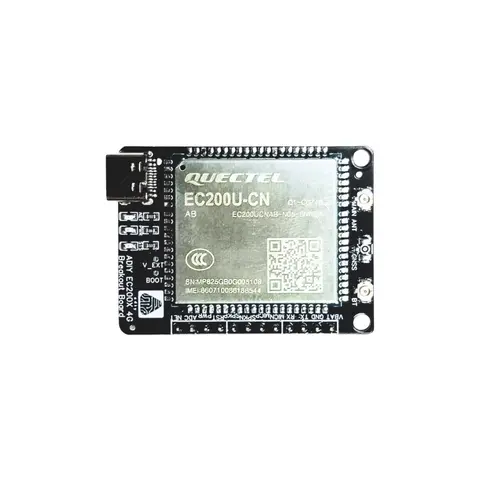
ADIY GSM EC200U 4G/2G BREAKOUT BOARD
The ADIY EC200U 4G LTE GSM Breakout Board is a high-performance Cat 1 solution designed for reliable wireless communication. It supports multiple modes, including LTE TDD, LTE-FDD, GSM with 2G fallback capability to…
₹1,516
Datasheet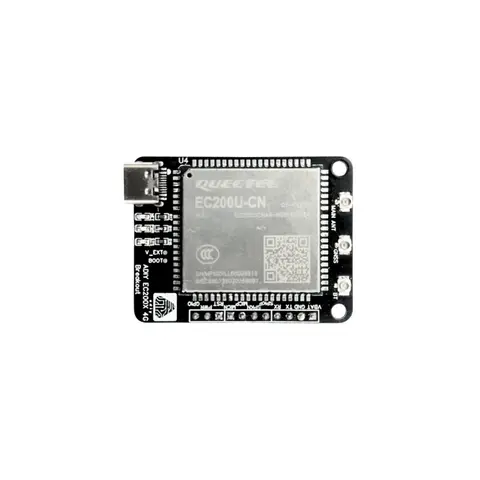
Wireless Modules
ADIY GSM EC200U 4G/2G GNSS BREAKOUT BOARD
The ADIY EC200U 4G LTE GNSS Breakout Board is a high-performance Cat 1 solution designed for reliable wireless communication. It supports multiple modes, including LTE TDD, LTE-FDD, GSM, GPRS, and EDGE, with 2G fallback…
₹1,720
Datasheet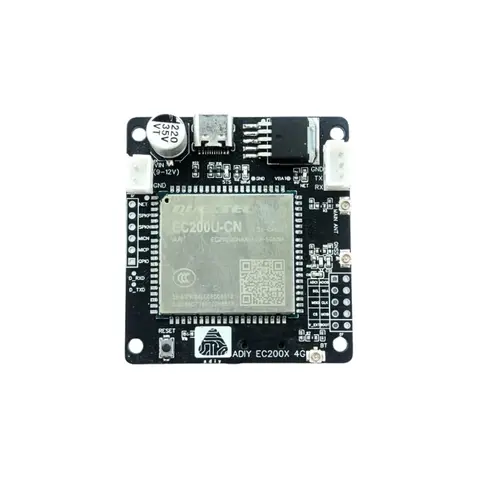
Wireless Modules
ADIY GSM EC200U 4G/2G GNSS LM39302 Board
The ADIY EC200U 4G LTE GNSS Development Board is a high-performance Cat 1 solution designed for reliable wireless communication. It supports multiple modes, including LTE TDD, LTE-FDD, GSM, GPRS, and EDGE, with 2G…
₹1,940
Datasheet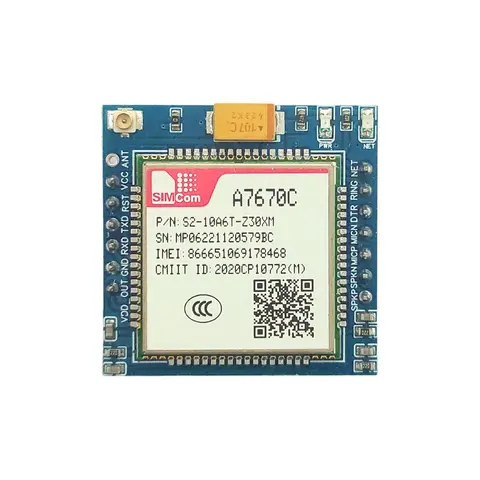
GSM Modules
ADIY GSM SIMA7670C 4G BREAKOUT BOARD (Ver 1.1)
A7670C 4G Development Board A7670C 4G Development Board is a high-performance Cat-1 module that supports LTE-TDD/LTE-FDD wireless communication modes. With a maximum downlink rate of 10Mbps and an uplink rate of 5Mbps,…
₹1,200
Datasheet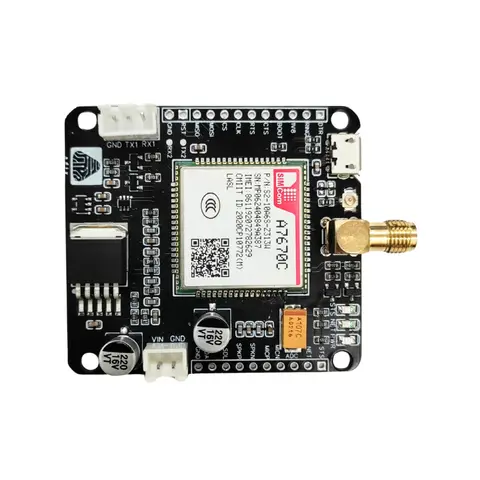
GSM Modules
SIMA7670C 4G/LTE GSM Board (LM39302) V1.1
The ADIY SIM A7670xx 4G LTE Board is a Cat-1 Module which supports wireless communication modes of LTE-TDD/LTE-FDD. It supports maximum 10Mbps downlink rate and 5Mbps uplink rate. This board features a serial interface…
₹1,447
Datasheet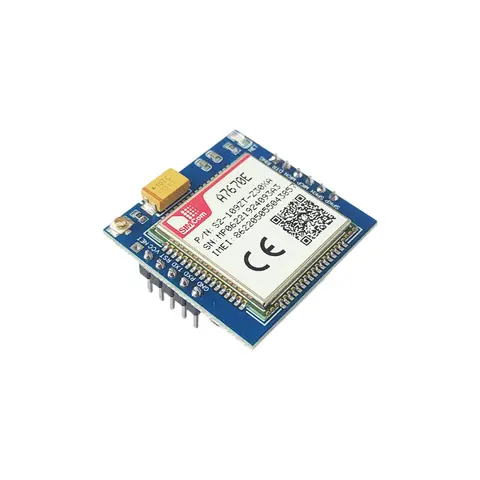
GSM Modules
ADIY GSM SIMA7670E 4G/2G Breakout Board
SIMA7670E 2G/4G Breakout Board module supports wireless communication modes of LTE-FDD/GSM/GPRS/EDGE GSM/GPRS. It supports a maximum 10Mbps downlink rate and a 5Mbps uplink rate. The ADIY SIM_A7670E is compatible with…
₹1,438
Datasheet
Share